Between Fear and Love
Fear comes first. Not the sudden and obvious kind, but a quiet fear — almost motionless. The kind that stops a gesture a moment before reaching out to another person. The kind that makes us hesitate for a second longer than necessary.
One might imagine a woman making her way through the crowd accompanying a condemned man to his execution, aware that a single careless movement could be enough for her, too, to become caught up in the violence. And yet she approaches him. She holds out a cloth. She wipes the face of a man condemned to death.
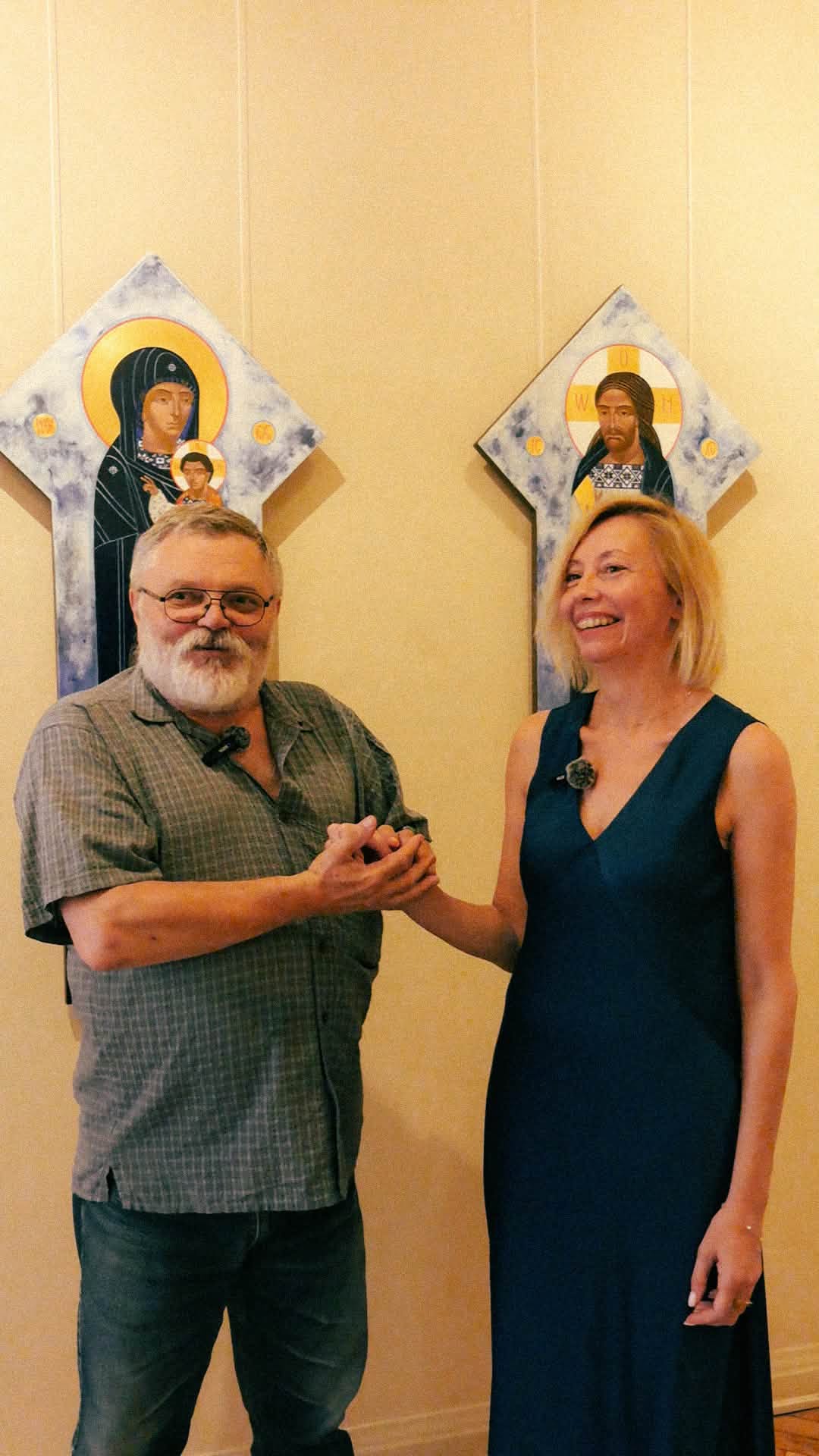
It is precisely at this moment — in the tension between fear and compassion — that the meaning of Uliana Tomkevych’s images begins to unfold.
All the themes explored by the artist originate in the New Testament. Yet they are neither illustrations of familiar stories nor attempts to reproduce them literally. Here, figures and events from the Gospels become a space of existential tension, in which the human being finds themselves caught between two forces — fear and love. This tension continually resurfaces, creating the underlying drama of the entire project.
It manifests itself most vividly in the figure of Veronica. Her gesture was not an act of serene devotion. Christ was walking the path of a condemned man — publicly humiliated and subjected to one of the cruellest and most degrading forms of punishment known in antiquity. To approach Him meant crossing the boundary of safety. Veronica must have been afraid — and it is precisely this that makes her act so moving. Not because fear disappears, but because love overcomes it.
A similar dynamic can be seen in the scene of the women carrying spices to Christ’s tomb. They know that the place of death is not safe: guards are stationed there, soldiers are present, tension fills the air, and even the simple gesture of honouring the dead carries a certain risk. And yet they go. In this sense, they become an image of every person who tries to act despite fear — not outside it, but by passing directly through it.
Nor can we overlook the context in which these images have emerged. The war is almost entirely absent from them as a direct presence — with the exception of one unsettling motif of a submarine — yet it is difficult to look at this cycle while ignoring its presence. Here, war remains a latent tension beyond the frame: invisible, yet constantly felt. It is precisely this that allows the New Testament narratives to resonate anew — as stories about crossing the threshold of fear in a world where the very boundary of safety is constantly shifting, slipping away, and disappearing.
The context in which these works were created is equally important. The collaboration with the Faculty of Arts at the University of Siedlce and the Diocesan Museum in Siedlce represents more than institutional support; it becomes a condition for creative exchange. Encounters with different ways of understanding the sacred image, dialogue with history and tradition, and engagement with different artistic sensibilities open up a space for creativity that is not confined to a single interpretation.
It is precisely this multiplicity of voices that seems to be one of the most compelling aspects of the project. The aim is not to confirm what is already evident, but to uncover within it something that does not lie on the surface.
The artistic mentor of the project was Dr hab. Tomasz Nowak, Professor at the University of Siedlce and Dean of the Faculty of Arts at the University of Siedlce. His involvement extends beyond that of a formal supervisor; it becomes an important part of the creative process, through which Tomkevych’s painting acquires an additional dimension of reflection. It is an encounter between two sensibilities, two ways of thinking about the sacrum, the image, and tradition, as well as about how ancient motifs can become vehicles for distinctly contemporary anxieties.
In this sense, Tomkevych’s icons are radically contemporary. Rooted in tradition through their craftsmanship and the technique of egg tempera, they retain the gravity of spiritual experience while formally departing from established notions of the classical icon. This does not diminish their seriousness; on the contrary, it opens up space for a new way of seeing. Here, the sacrum ceases to be a safe refuge; it becomes a question.
The project was created as part of the Gaude Polonia scholarship programme of the Polish Ministry of Culture and National Heritage — a programme designed to foster cultural dialogue between Poland and the countries of Central and Eastern Europe. Within this context, Tomkevych’s images acquire an additional layer of meaning. They speak not only of religious narratives.
They speak of something far more fundamental: the moment when a person, despite fear, chooses to remain human.
Author: Dr Marcin Sutryk